25 October 2026 · 10 min read
How to Start a Blog: The Real Obstacles and What Keeps You Going
For two years I wanted to run a blog and kept putting it off: no gear, no space, no time, no confidence, no energy for editing. Here is what I removed, and in what order.
The idea of running a blog came to me two years ago. I first started a year ago: I joined a free challenge, shot, edited, and enjoyed it. It drove me. A couple of videos took off, one got about 79,000 views, people subscribed, and every new subscriber fed my motivation for a while.
The drive didn’t last. Editing took a lot of time, and I enjoyed it less with every video. Then a move and a job change came along, I had no time left, and I dropped the blog for a year.
The wish itself never went away. All year I felt pulled to show up and be heard. So much was happening in my life and in the world of AI that I felt right in the middle of events and wanted to talk about it. But every time I thought about starting again, I ran into the same things. I later told the story of that year in a short video (in Russian): “I couldn’t post a video for a year: procrastination, fear and shame”.
What stopped me from starting
This is my list, the way I eventually wrote it down on paper:
- gear: setting up equipment takes a while, and I had no gear of my own, neither a computer nor a tripod;
- I had no place or light to shoot in either;
- I didn’t know the method and had no system;
- shame, fear of being judged and plenty of other psychological barriers;
- there wasn’t enough time;
- I was afraid I’d have to edit for hours again;
- there was no feedback;
- I didn’t know what to talk about.
Each item can be solved on its own. Together they turned out to be far stronger than the single wish to start. I pictured it as a scale: the wish on one pan, a dozen small obstacles on the other, and while the second pan is heavier, starting is always easier tomorrow.
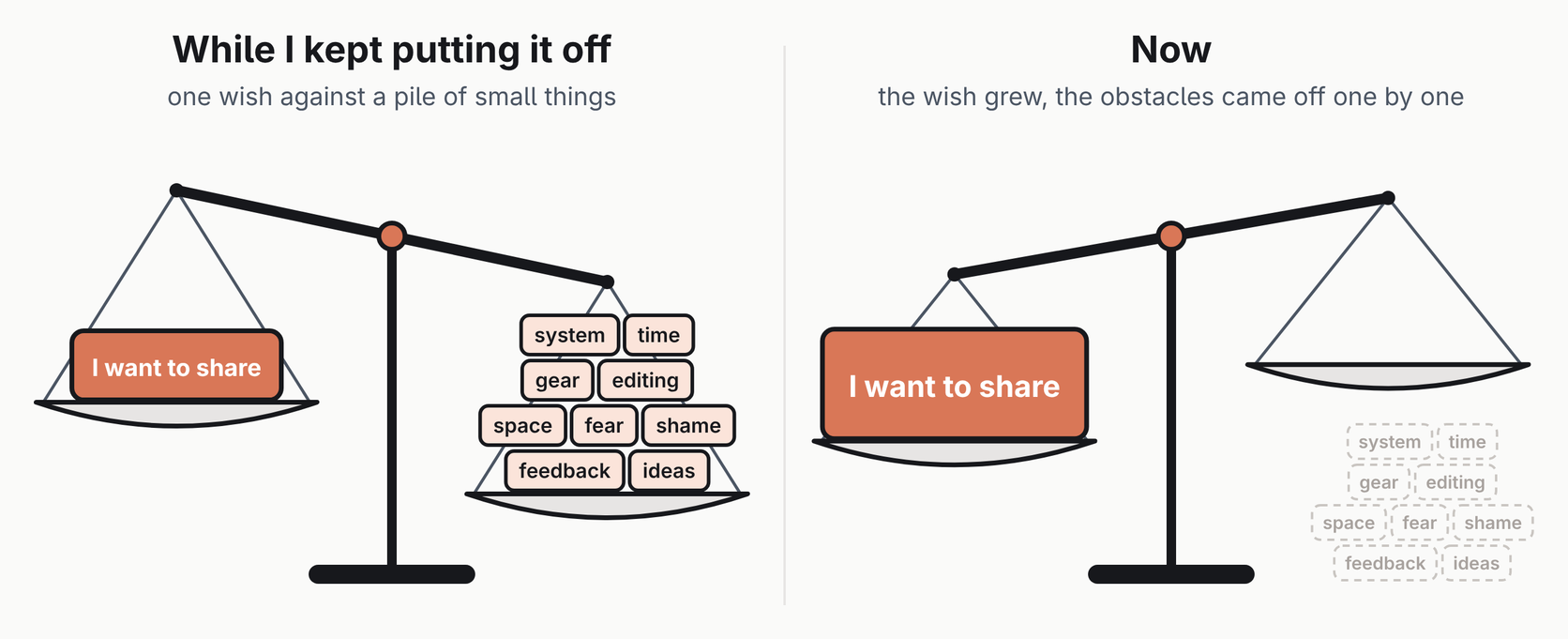
You can move the scale in both directions: strengthen the wish and remove the obstacles. I managed both.
The psychologist
The first big shift came from working with a psychologist. I went through a series of inner changes, and the need to show up grew so strong that the wish started to win. I wanted to let my creativity out more than I feared it.
Then I sat down and wrote out every reason I wasn’t doing what I wanted. Written down, they stopped blurring into a single “I can’t” and turned into a list of concrete tasks.
The illusion of simplicity
Going through the list, I realized that social media had given me an illusion of simplicity: the person on screen speaks effortlessly, the video is neatly edited, and it all looks like something done between other things. That thought became my first big article on this site, about how hard it is to cross into a new field. I covered the same ground in the third episode of my podcast (about 43 minutes, in Russian).
In reality there is titanic work behind the start, and behind a blog in general. The amount of knowledge and skill is comparable to programming. I know this first-hand: twelve years ago I moved from engineering to programming, and I remember how hard and long that was. Besides, many well-known bloggers had dealt with film and shooting before they began. I’m an ordinary guy off the street who had never filmed or been filmed. I tried to count the bloggers I know from my small hometown of a hundred thousand people, and it came to about one in ten thousand. Those were my odds too.
That helped me drop the illusion and the self-criticism and look at the situation soberly. I gave myself time, felt sorry for myself and stopped demanding quick results.
A computer of my own
The second step was buying a personal computer. I used to have only a work laptop and my wife’s computer. When motivation showed up, I either asked my wife for her computer and it was busy, or I sat down at the work one and realized I didn’t want to record my screen or upload personal videos on it.
When I bought my own computer and put Omarchy on it (it’s a Linux distribution), something broke loose, and not only for the blog. Since childhood I’ve loved getting lost in gadgets, and I suddenly realized how long I had denied myself that. I installed and removed programs, tuned the system, changed themes, played, started projects. I bought a Claude subscription, tried Alibaba, opencode and OpenRouter, updated my site, started a course. I didn’t know what to grab first, in a good way. I felt happy, alive, like a kid.
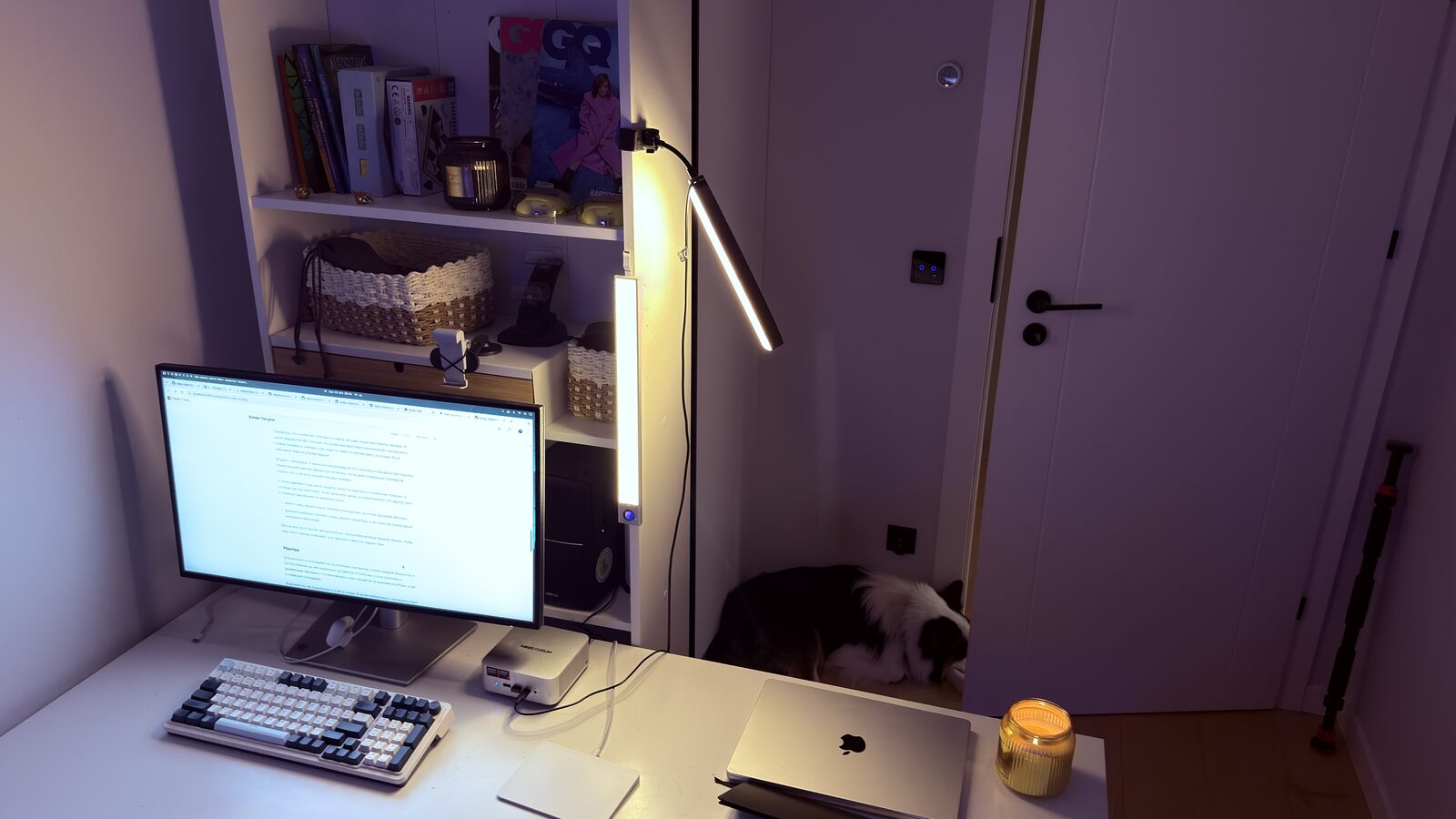
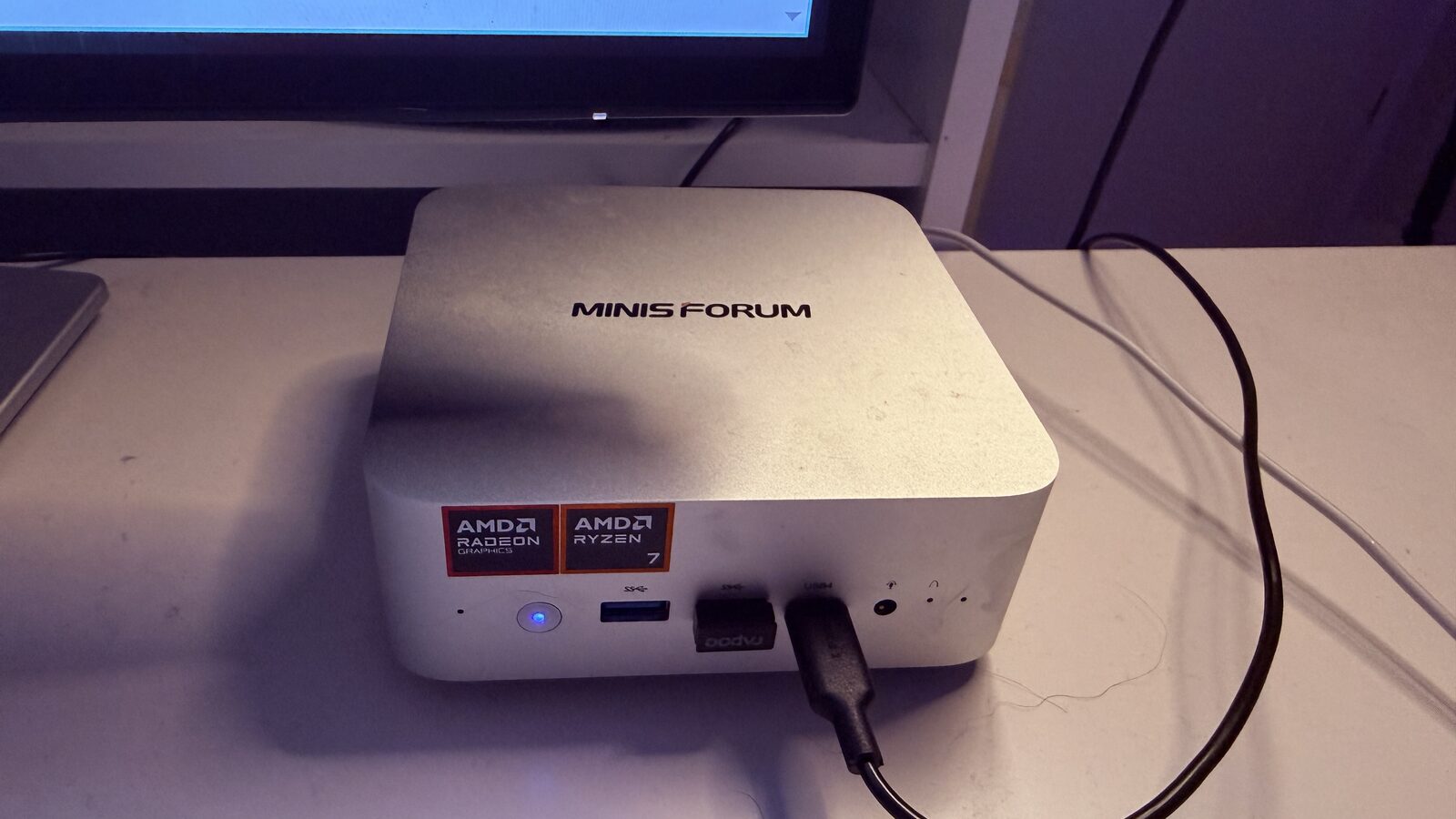
This is only indirectly about the blog. But the computer removed the most awkward obstacle, and the joy of a favorite hobby gave the wish more strength.
Tripod, microphone and light
After that surge I couldn’t help sharing. I kept digging: what stops me from recording a video the second the urge appears?
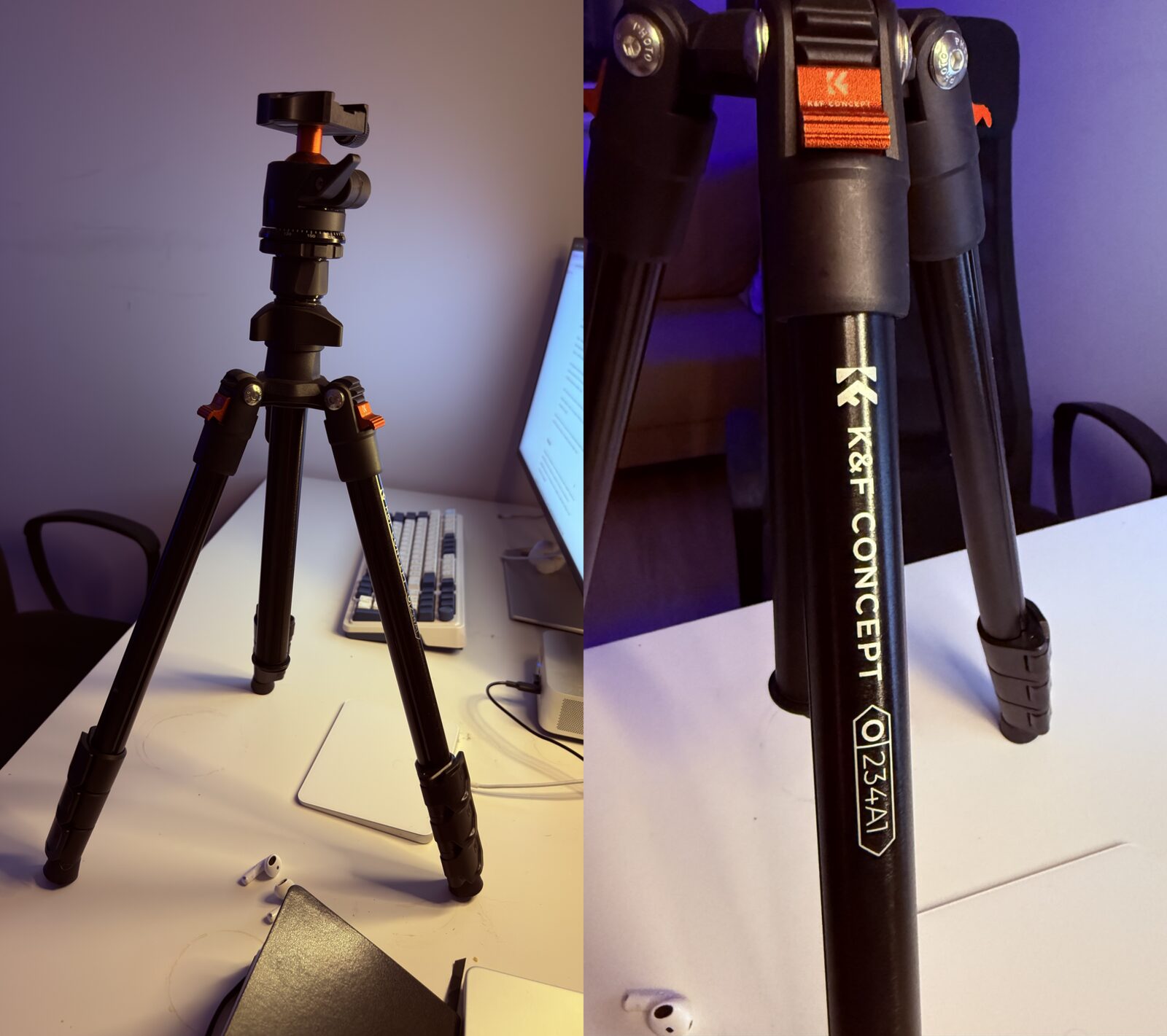
It turned out I had no tripod and often didn’t know where to prop my phone. I bought an inexpensive K&F Concept. It unblocked me more than anything else: I put the phone down and shoot standing, sitting, with the light and against it, outdoors. If you’re starting out, get a tripod first.
Second is the microphone. My wife already had a wireless DJI, so I didn’t need to buy one. Otherwise I’d recommend an inexpensive lavalier, even a wired one. Just check that it has a connector for your phone.
By then the shame had begun to fade: practice helped, and so did understanding the traps our brain sets for us. I could hit record at any moment. Light was what remained, and I picked two modes by time of day:
- by day I sit facing the window with my back to the computer, and the desktop wallpaper behind me is a nice one;
- in the evening it’s the other way round, my back to the window and my face to the monitor, with a neon controller on the wall behind me. A magnetic lamp that I took out of the closet lights my face.
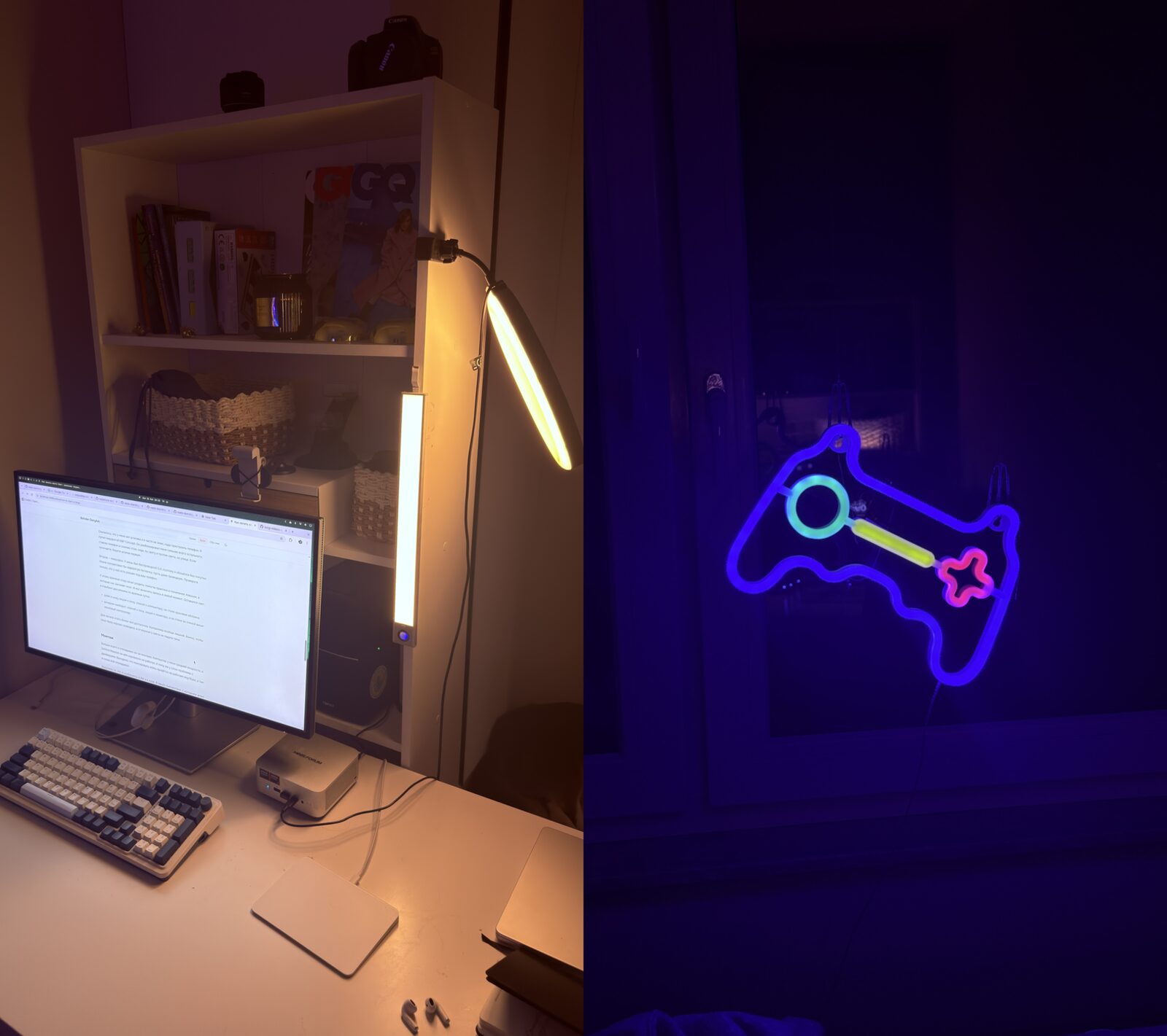
That is more than enough to start. The controller is unnecessary altogether. What matters most in lighting is the face. The light should hit it at roughly 45 degrees, so the lamp stands to the side, not straight overhead, and overhead light doesn’t cast shadows.
Editing
Editing was what I put off most. My computer is mid-range, and DaVinci Resolve didn’t run properly on it. On top of that, Linux has driver problems. It meant I’d have to edit on the work laptop again, and there I’d procrastinate again.
What saved me is that I know AI and code. I found libraries that let an agent edit video to my requirements: Remotion builds a video from code, FFmpeg cuts and joins, Whisper turns speech into text so the agent knows what is said where. It handles this better than I could in Resolve.
I won’t win an Oscar for this editing. But the fear of losing three hours on one video is gone, and the result is better than what I managed by hand. The limits are the hardware, my skills and the number of tokens, not what the technology can do, so I see big prospects here.
Here is how it works now:
- I shoot the video and upload it to cloud storage.
- I tell Claude what I shot and what I want in the end.
- A couple of hours later I pick up the result or ask for a fix.
The agent makes fixes surgically, so the second wait is shorter.
The agent doesn’t come up with a style on its own, of course. When I started posting more or less regularly and took on 30 days of reels in a row, I began studying how it’s done through the course and analyzing popular videos. And once again I called on my Pokémon. We wrote a script that breaks any reel into shots, segments, a second-by-second transcript, a color palette and a structure: the hook (what grabs attention in the first seconds), the pain and so on. What I get is a description of why a video took off and how to repeat the move.
One finding surprised me: editing pace decides almost nothing. Of the 18 most popular videos I analyzed, four were shot in a single take with no cuts. Separately, we analyzed the styling of hundreds of reels and put together a kit for my videos: the font, colors, effects and animation. So “the agent did it itself” means for me that it followed a plan agreed in advance.
What to talk about
Not knowing what to talk about held me back too. I started keeping notes during the day and doing a weekly review, writing out the main things. That gave me dozens, then hundreds of topics. I automated this with agents, but a notebook is enough.
The setup that works now
That removed the last obstacle, and I found what is, so far, the ideal setup for me. I love recording long podcast-style videos where I share the events of the week, and I combined that with short videos. I record a long video about what matters and what I want to say, hand it to the agent, and it processes it and cuts the sharpest moments into short videos.
I’m happy with it. In the last week more than a hundred people subscribed to me, and reach grew tenfold: from a couple of hundred to a couple of thousand.
What’s next
I know this is not an ideal setup and my video quality is far from ideal. But the limits are behind me, and the blog is now work like programming for me: I have plenty of thoughts, data to analyze and experiments, and a burning desire.
I’m only halfway through the course on short reels, and for now I shoot what I study plus small experiments. Next I want to take courses on long horizontal video, on writing articles, on AI video generation and on storytelling. Along the way I’ll learn to make useful content: content that is interesting to watch and listen to and that people want to share. So that it helps someone the way it helped me.
I caught a flow and understood how limited we are by frameworks, psychology and society until we create something. Once you start, it’s impossible to stop.
At a glance: what got in the way and what helped
| What got in the way | What helped |
|---|---|
| The illusion that a blog is easy | Accepting that it’s a craft and giving myself time |
| Shame and fear of judgment | A psychologist, then practice |
| No computer of my own | A personal computer, even if not the most powerful |
| Nowhere to put the phone | An inexpensive tripod |
| Bad sound | A lavalier mic, even a wired one |
| Light | Two modes: facing the window by day, facing the monitor in the evening |
| Hours of editing | Agent editing to a style agreed in advance |
| No idea what to do and how | A course and analysis of popular videos |
| Nothing to talk about | Notes during the day and a weekly review |
| Too little time | One long recording a week that the agent cuts into short videos |
If you are putting things off too, start with a list like this: write down everything that gets in your way, one item per line.
Examples: long episodes and short videos
All of these are in Russian.
Long episodes on YouTube
- ЧБ Подкаст №5: I post short videos for 30 days, and here is what I understood (about 26 minutes): a week in podcast format.
- ЧБ Подкаст №3: how our brain deceives us, why it is so hard to learn a new profession (about 43 minutes): the same conversation as in the article about the transition.
Short videos on YouTube
- I couldn’t post a video for a year: procrastination, fear and shame
- How to post 1 video a day when you have no time or energy?
- 4/30 Learning to speak to the camera
- Reel «I was afraid I’d be fired because of videos»: a short video cut from the podcast.
- The first video of my reels-course diary: day 1 of 30.